v1 is “complete modeling”: what that means
Solid, surface, SubD, sheet metal, mesh and assemblies in one app, with every claim backed by an acceptance test.
We call LocalCAD's first release "complete modeling". It's a strong phrase, so here is exactly what we mean by it, and how we check it.
Complete modeling means everything you need to model a product: not to document it, manufacture it or simulate it. (Rendering, 2D drawings and send to slicer have since been built on top of it; they are in the app and in final verification with v1.) Inside modeling, v1 covers five kinds of body in one design, plus assemblies and configurations:
- Solids from constrained sketches, with the full set of parametric features and a timeline you can roll back, reorder and suppress.
- Surfaces for shapes solids can't describe: 15 feature types, including G2 patches, with zebra and curvature analysis.
- Form bodies: freeform subdivision surfaces with 26 tools that convert to smooth solids.
- Sheet metal with rules, flanges, unfold and refold, and flat patterns to DXF.
- Meshes from scans or downloads, repaired and converted to B-rep.
- Assemblies with joints, motion studies, interference checks and a bill of materials, plus configurations driven from a table.
Claims backed by scenarios
Each area has acceptance tests, and v1 has six end-to-end scenarios that run in the real app, with real windows, Metal and the geometry kernel, and networking blocked. A few of them, as they ran on 20 November 2026:
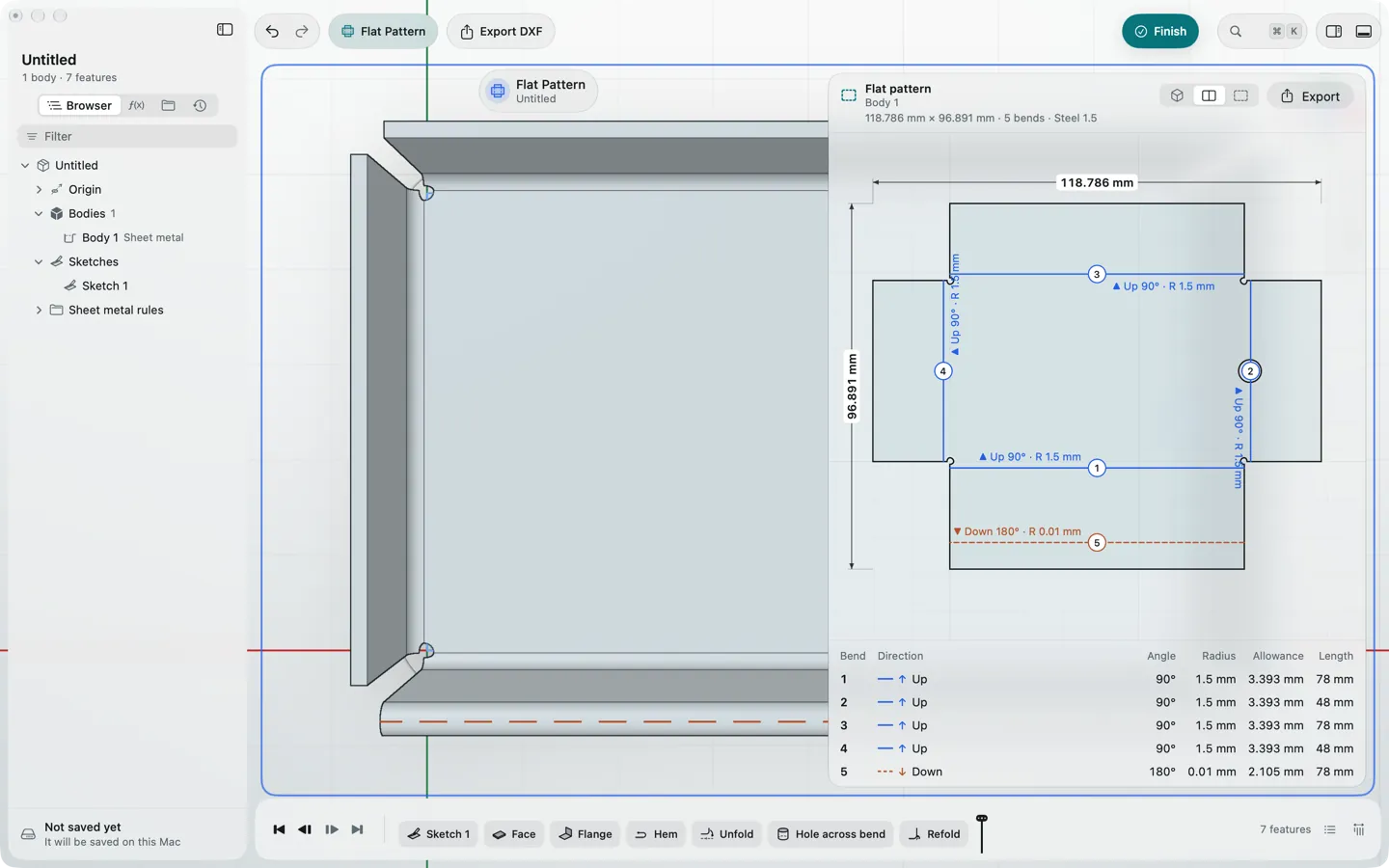
A sheet-metal enclosure
Steel 1.5 mm rule, a face, four flanges and a hem; unfold, put a 6 mm hole across a bend, refold; then export the flat pattern with its five bend lines. The flat length came out at 118.7858 mm, which matches the hand calculation to within 1e-13 mm, and an independent reader parsed the DXF.
A consumer-product shell
Start with a Form box, move vertices with mirror symmetry (the mirror image moves exactly −3 mm), crease the bottom loop, finish, convert to a solid of 55,021 mm³, and shell it at 1.5 mm with the top removed, leaving 9,287 mm³. Then undo all four steps to an empty design, and redo them.
Scan to part
Import an STL, repair it, reduce it by half, plane-cut it and convert it to a prismatic solid with six faces and 4,800 mm³. A fillet then removes exactly (4 − π)·20 mm³. Change the reduce step and everything downstream recomputes, with every feature still valid.
A 50-part mechanism
Ten external designs placed twenty times, plus thirty standard parts; a gear pair on revolute joints with a motion link. The drive solves at 30 or more steps per second, the motion study plays at 85 frames per second or more, and the interference check finds exactly the four press fits we designed in.
What's not done
We'd rather you hear it from us. v1 is not signed off yet. Known limits today:
- The first interference check of our largest test assembly takes 21–28 seconds; we want 5.
- The design review that signs v1 off is still in progress.
- Box selection is missing in sketch mode, and Form has no pull-to-target yet.
- The current build needs macOS 27 on Apple silicon.
Since this post was first drafted, rendering, 2D drawings and send to slicer have been wired into the app. Next: CAM, then simulation. The full list is on the roadmap.